RSS

What I think: Buying a used BMW 5 Series

Last week, I told you how much I like my in-laws’ lovely near-vintage 5 Series; today, my used car column at Autos.ca looks at what it’s like to own a newer 5 Series. The short answer is that you’ll likely get to know your mechanic really well. Read the full article here.

 
Leave a comment

Posted by on August 11, 2011 in BMW, Used vehicles


What I think: 2011 Ford F-150 EcoBoost

By Chris Chase

Torque is a work truck’s best friend. This measurement, which indicates the amount of twisting force an engine generates, tells the truest tale of how much power the motor possesses. It’s also the number you need to concern yourself with if you plan to regularly tow or haul heavy things with your truck. Big horsepower numbers ensure quick acceleration and high top speeds, but torque does the grunt work.
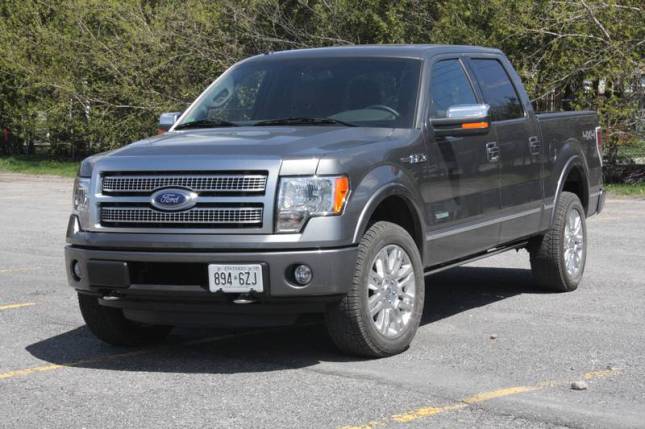
Typically, torque has been the domain of the V8, with six-cylinders being the base engine in most full-size trucks for many years. Ford is taking a new tack with the 2011 F-150, offering a turbocharged V6 as an alternative to (though not at the exclusion of) V8 power.
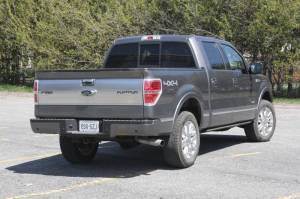
It’s part of the company’s EcoBoost engine program, which will see smaller-displacement turbocharged powerplants offered alongside more traditional engine options in a variety of vehicle types. Among the first Fords to get EcoBoost action were the Taurus SHO and Flex, and the Lincoln MKT, all of which use the same turbocharged, 3.5-litre V6 found in the F-150 pickup I tested a few weeks ago.

In the F-150, the EcoBoost motor makes 365 horsepower and 420 lb-ft of torque, more of both than the 5.0-litre V8 (360 hp/380 lb-ft) that’s also available produces. For drivers after as much power as they can get, but happy to gloat that their more-potent motor is also more efficient, maybe this motor should be called EgoBoost. Whatever the name, it’s presumably a boost to Ford’s bottom line, as the company’s strategy is to market its turbocharged engines as an upgrade from a similarly-potent non-turbo engine. Hence, this turbo six is a $1,000 option compared to the 5.0-litre.

On paper, $1,000 for five horsepower and 40 lb-ft of torque sounds like a raw deal, but in practice, at least from a performance perspective, it seems like money well-spent. The EcoBoost’s higher torque output comes at a lower engine speed – 2,500 rpm, versus 4,250 for the 5.0-litre’s 380 lb-ft – and the result is a truck that is very responsive from a stop. The available low-end grunt is such that, when using the transmission’s manual shift mode, the engine pulls strongly even without shifting down from top gear at near-highway speeds.

That transmission is a six-speed automatic, the only one offered in any F-150. It works well in normal driving, but the first-to-second upshift gets harsh when creeping along at gridlock speeds. My suspicion is that this transmission was designed for heavy hauling, not the 9-5 commute, and so silky-smooth performance in such conditions wasn’t a priority.

With power and torque figures not far off those of the 5.0-litre V8, Ford says the EcoBoost’s main benefit is in fuel consumption; the idea is that a smaller engine with a power-adder like a turbocharger should use less fuel than a V8 with similar power numbers. The F-150 EcoBoost’s government fuel consumption ratings are 13.9/9.4 L/100 km with four-wheel drive; by comparison, the less-powerful 5.0-litre 4×4 is rated 15.0/10.5.

My EcoBoost tester averaged 15.5 L/100 km in a mix of city and highway driving. I think that’s a good result for a truck like my massive SuperCrew tester, and while you could expect that the 5.0-litre would have been thirstier in the same circumstances, don’t get your hopes up that the EcoBoost mill will turn this truck into a Prius at the pumps.
The last F-150 I tested was a 2009 with the old 5.4-litre V8, a truck that averaged 21 L/100 km in winter driving. A 2011 F-350 Super Duty with the latest Powerstroke diesel V8 managed an average in the high 16s last summer.

The only flaw in this engine’s performance is a pretty superficial one: it lacks the auditory attitude of a V8, or even the snarkier-sounding 3.7-litre base V6. Aside from some turbo whistle at wider throttle openings, the turbocharged F-150 sounds more like a Taurus than a truck.

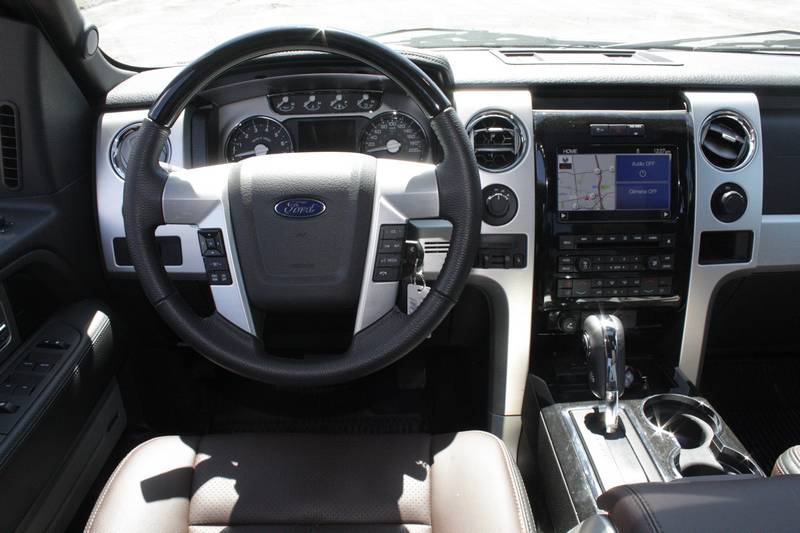
The F-150’s four-wheel drive system is an electronic setup controlled by a rotary dashboard knob; options are two-wheel drive, and low and high ranges in 4WD mode.

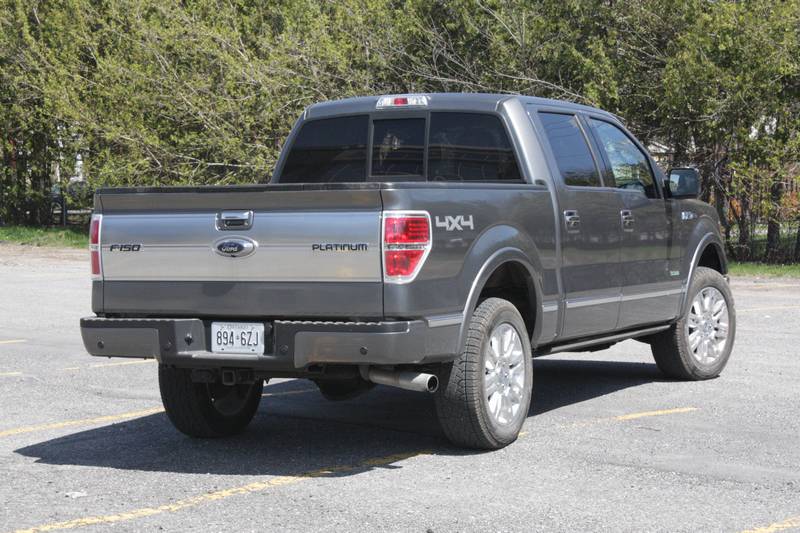
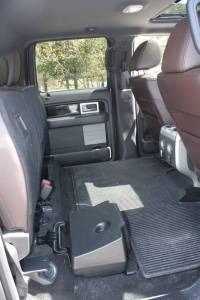
When optioned with the SuperCrew cab as my tester was, the cabin is huge, with the extra space going toward rear seat accommodations, which are as spacious as a full-size luxury sedan’s; think along the lines of a BMW 7 Series in terms of leg- and headroom. In Platinum trim, the interior is indeed luxurious, too, with brown leather on the seats, heated and cooled front seats and two-temp heaters for the rears. The brushed metal and black woodgrain trim on the dash and doors looks pretty slick, too. The cabin is wide, and so are the seats, making for easy comfort in the supportive front buckets. The rear seat should easily fit three average-sized adults.

When you have more cargo than couples to bring along, the bottom cushions of the rear seats fold up, creating a terrific amount of space for bulky cargo that needs keeping dry. In my tester, the only impracticality back here was the (700 watt!) sound system amplifier, under the right-side rear seat. At least the stereo sounded great.

This brings me to an opinion I share with friend and fellow automotive journalist Jil McIntosh. In her recent review of a 2011 Ram pickup she tested, her observation was that trucks have undergone a significant amount of bracket creep in the last 10 or 15 years. My F-150 tester is as large as a previous-generation F-350 Super Duty (I know this from parking beside one), while the current Super Duty is an order of magnitude larger than this one.

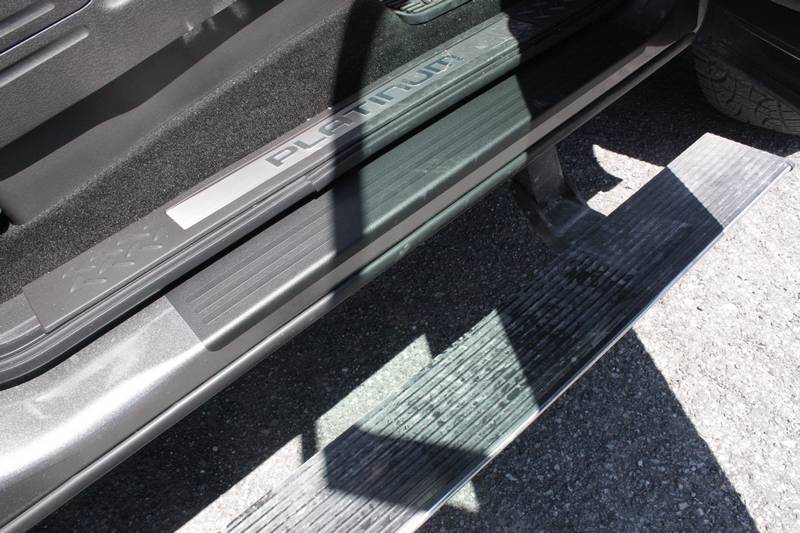
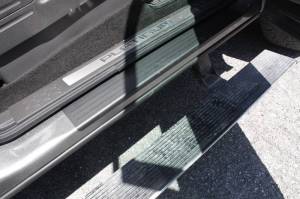
Bracket creep in the auto industry is normal, but trucks have grown in height to the point that my tester’s electric, retracting running boards are practically a necessity for getting in and out of the vehicle, unless you want to cart a stepladder around everywhere you go. Categorically, I’ve nothing against convenience features like this, but what I don’t see is a direct correlation between tallboy trucks and payload/towing capacity. The full-size truck segment is beginning to look too much like a game of mine’s-bigger-than-yours. EgoBoost, indeed.

For the record, those power running boards (standard only in Platinum trim) can be deactivated to prevent them from deploying when they might get damaged – when parked over rough terrain, for example.
With the EcoBoost engine, the F-150’s max payload is 943 kg (2,080 lbs), and towing capacity maxes out at 5,125 kg (11,300 lbs). Those figures are for the lighter, regular cab model; the extra weight of extended cabs and bigger boxes eats into those capacities, so my tester’s figures were closer to the minimums of 3,628 kg (8,000 lbs) for towing and 798 kg (1,760 lbs) of payload. My buddy Mark, who always has a home improvement project on the go, needed a bunch of concrete mix, so we took the truck to the hardware store and lugged a dozen bags (800 pounds/360 kg worth!) of the stuff into the bed, where it made a noticeable, but not dramatic, difference in straight-line performance, and a marked improvement over the empty truck’s ride quality.

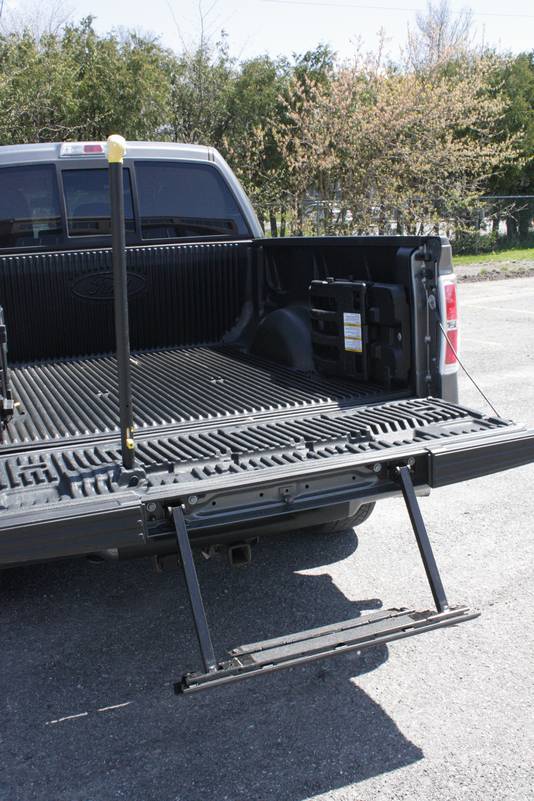
The SuperCrew cab can be ordered with either a 5.5- or 6.5-foot box; my tester had the shorter of the two, plus a bed extender that stretched the box to seven feet when in place. Ford’s foldout tailgate step and its attendant grab handle eased access to the bed. Even with what I think is a pretty small box for a big truck, the SuperCrew cab’s long wheelbase makes it a handful in tight situations.

Mark noted a couple of things he’d change about this truck: he wanted kick-out steps at the side of the box, for easier access to the contents without having to climb into it. And he made a good point about Ford’s tailgate step: when it’s deployed, it gets in the way of someone on the ground passing heavy stuff up to a partner in the truck bed. His suggestion was to offset it to one side of the tailgate so that it doesn’t have to be stowed again before loading stuff into the bed.

The steering is light, but road feel is negligible and it gets vague on-centre, which leads to some lane wandering at highway speeds. Strong brakes are as important in a big, heavy truck as in a sports car capable of high speeds; the F-150’s binders haul things down to a stop with confidence, minimal fuss, and great pedal feel.

F-150 SuperCrew pricing starts $35,199, which includes the base, 3.7-litre V6 engine. My tester was a well-loaded Platinum model, at an MSRP of $60,499, plus $1,000 for the EcoBoost engine, $350 for the bed extender and $900 for a trailer tow package that adds a class IV hitch, seven-pin wiring harness, SelectShift (automatic with manual shift function) transmission and upgraded engine and transmission cooling; as tested, my truck was worth $64,399, including $1,450 for freight.

Outside of diesel and high-performance models, turbocharging is a rare tactic in the truck market. In this case, the EcoBoost six has big power to match the F-150’s imposing stance; all that’s missing is the gutsy V8 soundtrack that I think provides the biggest boost to many a truck owner’s ego.

This review was previously published at Autos.ca.

 
Leave a comment

Posted by on August 9, 2011 in Ford, Trucks, What I Think


What I think: 2012 BMW X1

The BMW X1 is a smaller SUV with a smaller engine and, most importantly, a smaller price. At a little under $40,000, the X1 is going to attract many new buyers to the BMW brand, and that’s probably a good thing, because the X1 is missing something key to BMW’s appeal with enthusiasts. Read my review at Autos.ca.
 
1 Comment

Posted by on August 8, 2011 in BMW, Crossovers/SUVs


What I think: Buying a used Kia Rio

This week, my used vehicle review at Autos.ca looks at the second-generation Kia Rio, built from 2006 through 2011. It’s a well-made little car, but its reliability doesn’t quite match up with the likes of the Toyota Yaris, despite similar resale values. Read the full review here.

 
Leave a comment

Posted by on August 4, 2011 in Kia, Used vehicles, What I Think


The Good Old Days: Driving a “mature” BMW

By Chris Chase

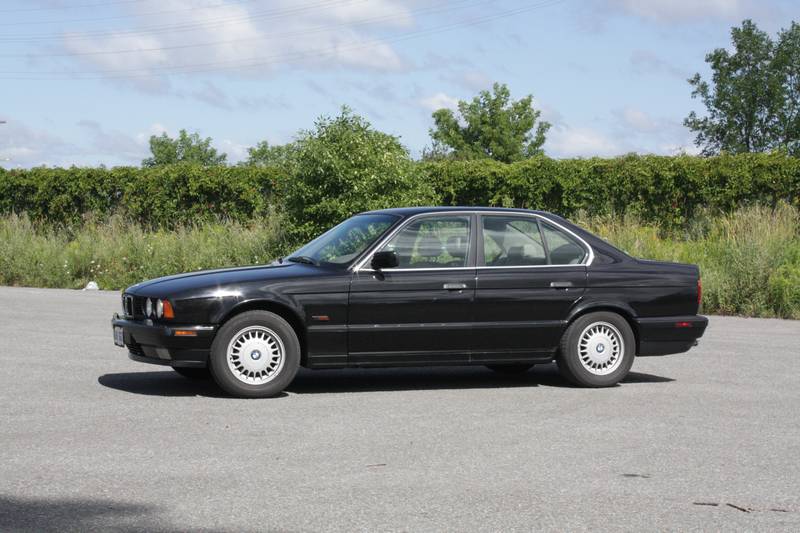
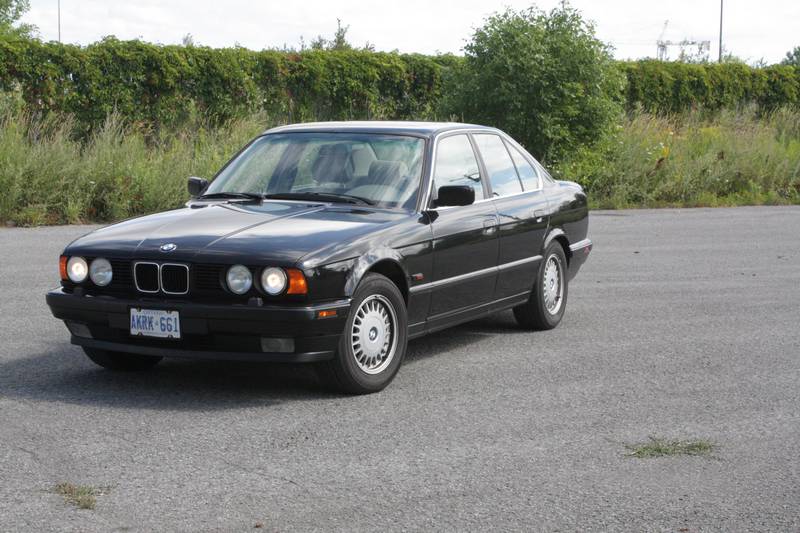
In 1997, my in-laws bought this car, a 1994 BMW 525i, second-hand.

My in-laws' baby, a 1994 BMW 525i

My father-in-law had debated getting the Touring (station wagon) model, but was turned off by the fact that BMW never sold it with a stickshift (or at least, they’re hard to find that way). BMW wagons are pretty swell, but its manual shifters are better, so I think it was a good trade-off.

Shortly after buying the car, my in-laws had the car shipped overseas so they could drive it during a four-year stint in Switzerland. If this car was a person, I’d like to think it had never been so happy, on that country’s well-maintained highways. It’s probably never been quite that happy since, either, particularly having spent much of the last three years in storage, here in Ottawa, while its owners were living in South America. I’ve been the car’s official custodian during that time, though that job ends this fall, when they move home.

The car still looks good for a 17-year-old; it has 343,000-plus kilometres on the odometer. I expect they’ll keep it another long while; it’ll spend winters from here on stored in their garage.

Front-hinged hood!

One of my favourite features is the front-hinged hood. My dad’s 1978 Civic had one, too, but they’re rare now.

Under that hood is a 2.5-litre straight-six engine. By today’s standards, its 189 horsepower and 181 lb-ft of torque are pretty modest; most four-cylinder family cars have that much power, if not more. This certainly isn’t a fast car, but the motor is really nice to listen to when it’s working hard. The shifter in this car is showing its age, with lots of play, but it still shifts nicely. The clutch is a beautiful piece of machinery to use.

You don’t see blocky dashboards like this much anymore; same for the huge expanse of blank surface around the shifter. You can bring a drink with you, but you have to hold onto it. Think new BMWs are stingy with cupholders? This one has NONE. On an unrelated note, I’ll take this car’s mechanical parking brake over the electric type BMW uses now.

Cupholders? Ha!

A fully-lined trunk is easy to take for granted in today’s economy cars; this one’s nice, but it’s not as deep as what you get in modern BMW sedans, and the back seats don’t fold. There’s a centre pass-through, though.

Drive around in this car, and you’re surrounded by noises. There are creaks from every corner of the interior, and the worn leather squeaks as you slide around in the slippery seats. The soft ride is probably partly due to a well-worn suspension, but I think it’s more an indication that back then, a sporty car didn’t have to ride harshly. That’s different now, and I think it’s a mistake. I’ll take a softer-riding car that can corner any day. The only place for a hard suspension is the smooth asphalt of a racetrack; on city streets, a rough ride feels nothing but cheap, at least in a luxury car.

This car’s steering is a far cry from that in just about any car built in the last 10 years. The on-centre dead spot is so wide that it feels like something’s loose at the front wheels. That’s the way it was designed, though, in the days before the complicated variable-ratio steering systems BMW offers now. It’s off-putting at first, driving a car with a steering wheel that moves through about 10 degrees of rotation before doing much to change the car’s direction. Toss it into a hard corner, though, and the steering feel improves dramatically. I did that once, and I spend every drive in the car looking for more corners to toss it around.

There are many things I like about new BMWs, but I still love the older ones more. It’s been fun getting to know this car.

 
1 Comment

Posted by on August 2, 2011 in BMW, The Good Old Days


Nuts and bolts: 2012 Honda CR-V concept

By Chris Chase

Concept vehicles are the ones normally seen at auto shows, often-radical styling exercises that suggest what’s in store for a carmaker’s future models. Honda’s concepts of late, though, have been more down-to-earth vehicles providing a very accurate preview of a coming-soon production model. Proof can be seen in the concept for the two-seat CR-Z hybrid (seen at the 2007 Tokyo auto show), and more recently, in the Civic concept (essentially a production model with blacked-out windows) that made the auto show rounds earlier this year.

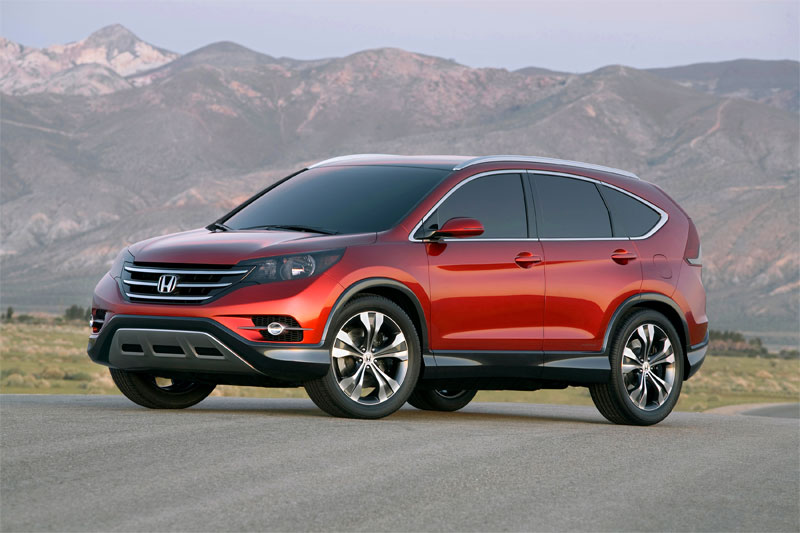
2012 Honda CR-V concept

Photo courtesy Honda Canada

Honda’s latest preview is of the 2012 CR-V Concept, unveiled July 25th. The CR-V is Honda’s entry in the compact crossover/SUV category, an important one in North America and one in which Honda has been a very important player since the first CR-V was introduced way back in 1997. This so-called concept is another thinly-veiled production model, the giveaway being Honda’s pronouncement that the 2012 CR-V will go on sale in Canada (and presumably in the U.S., too) early next year – far too soon to allow time for significant design changes.

The styling isn’t a total departure, but Honda’s being less cautious than with the 2012 Civic that just went on sale. Honda has more latitude here than it did with the Civic: the CR-V is important, but the Civic is practically the poster child for small cars in Canada. The concept’s front-end treatment is a kinder, gentler version of that found on the ungainly, unloved Accord Crosstour. The rear, from what’s visible of it in the single front three-quarter image Honda provided, retains the current model’s basic look, with bumper-to-roof taillights, but otherwise looks like a cross between the Volvo XC60 and Kia Sportage, neither of which are bad designs to crib style ideas from.

Based on the company’s press release, it seems Honda will stick with its strategy of offering a single four-cylinder engine in the CR-V, despite most of its competitors’ offering six-cylinder or turbocharged four-cylinder powertrains in uplevel models. Honda doesn’t say anything about performance upgrades compared to the current CR-V, but does boast of “top-of-class” fuel economy. Sounds impressive, but don’t expect miracles; a ten per cent improvement over the current front-drive model’s figures of 9.8/7.1 L/100 (city/highway) would be a generous estimate. The current CR-V is offered with just one transmission, a five-speed automatic. My guess is Honda will stick with it for 2012; the Sportage and Tucson already come with six-speed automatics, and the Toyota RAV4 still uses a four-speed with its four-cylinder engine.

Inside, Honda promises a “more accommodating and spacious design” and a lower cargo floor. The latter is the more interesting statement, as the CR-V is already one of the better vehicles in its class, along with the Toyota RAV4, for ease of cargo loading.

Honda’s on an unfortunate streak lately with many of its brand-new models being duds in the marketplace. It has had better luck redesigning existing successful vehicles, though, and the redesigned CR-V should do just fine. A lower price would help, and I do think Honda will cut the CR-V’s price for 2011, in order to keep competitive with Korea’s Kia Sportage and Hyundai Tucson – popular, well-designed vehicles that undercut the Honda by a significant amount. The 2011 CR-V’s MSRPs start at $26,290 for the base LX FWD model, and top out at $35,390 for the EX-L with navigation.

Notably, Honda will offer the CR-V in a Canada-exclusive Touring trim, and the 2012 model will be the first CR-V to be built at the company’s Alliston, Ontario manufacturing plant.


What I think: 2011 Nissan Quest SL

By Chris Chase

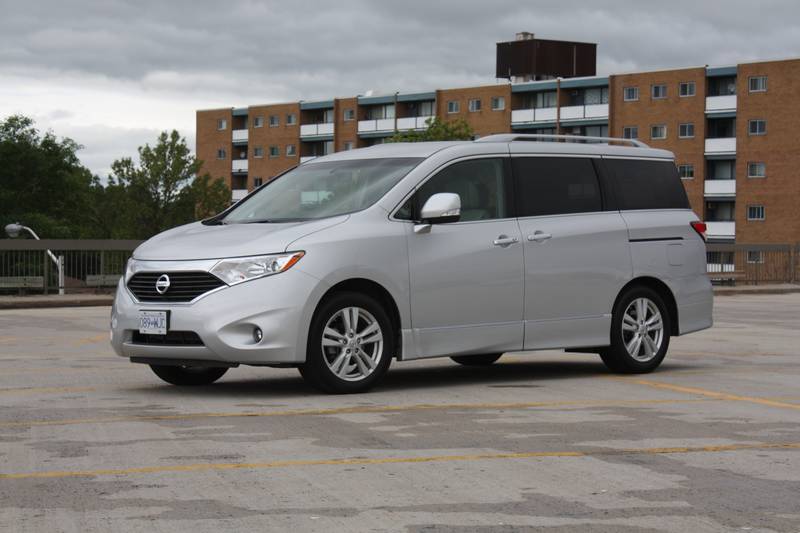
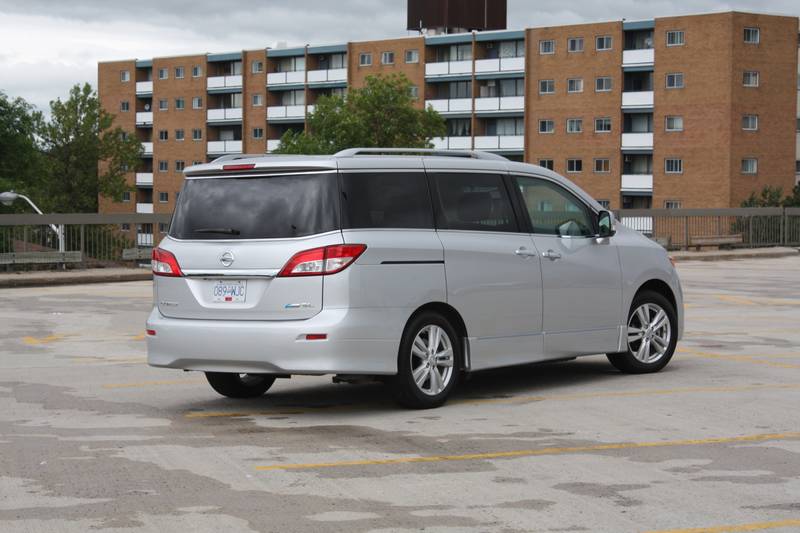
2011 Nissan Quest SL

2011 Nissan Quest SL

You might expect a company that builds crazy fun cars like the 370Z and GT-R to have an entire line-up of vehicles infused with a fair amount of amusement. Indeed, Nissan is no slouch in building performance-oriented vehicles, such as the Maxima and the SE-R version of the otherwise dull Sentra, not to mention a couple of Infiniti models that challenge the world’s best sport sedans.

However, it seems Nissan’s supply of fun factor ran out when it got around to putting together its redesigned 2011 Quest. Certainly, no one gets into a minivan expecting it to drive like a sports car, but even taken on its own merits the Quest was disappointing, with ponderous handling and vague steering, two aspects that were pulled sharply into focus on a back-roads cottage getaway. I’ll admit that my expectations were coloured by a recent test of the also-new Honda Odyssey, a van that carries itself with far more poise, with a tight suspension and unexpected cornering ability.

2011 Nissan Quest SL

2011 Nissan Quest SL

To be fair, the Quest’s soft ride won’t go unappreciated; that’s a great thing in a vehicle designed as a people-mover, and means it will attract buyers who appreciate the cushy ride of the Dodge Grand Caravan and Chrysler Town & Country twins.

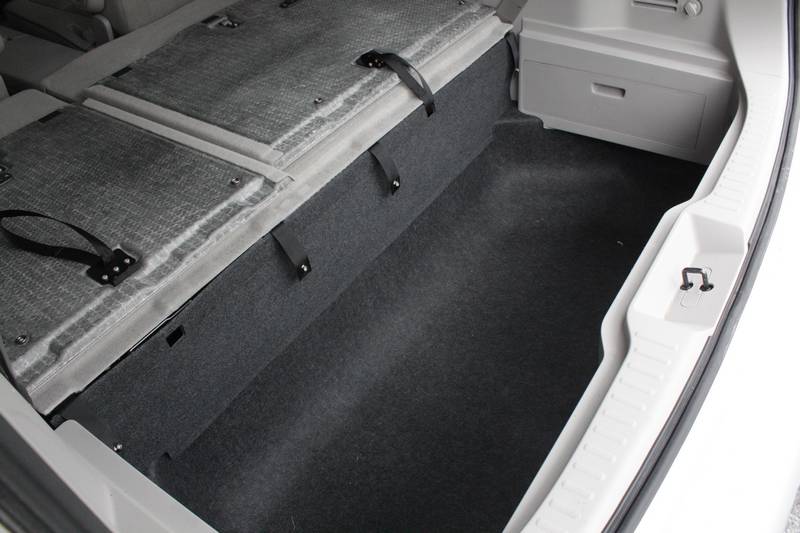
The Quest’s interior does play against type. One of its best features is the third row of seats that fold away forward, instead of back and down into the well behind them. This creates a permanent, covered “trunk” available no matter the positioning of the rear seats, a real, practical benefit for everyday use.

2011 Nissan Quest SL

2011 Nissan Quest SL

However, another against-the-grain design element doesn’t work as well: the second row seats that can’t be removed from the van. They do fold, but the result is a higher load floor with all seats down than in other vans, which limits the Quest’s maximum cargo space. Still, the Quest is a big vehicle, and the reduced cargo volume will only be a problem for transporting very large items too tall for the interior.

Nissan’s other interior trick is to play with perceptions to make the front seats spacious and yet give the driver the visual impression that he or she is piloting a vehicle sportier than a minivan. The dash and cowl are high and the windshield header squeezes down lower than in most vans, lending a gun-slit effect to the forward view. At the same time, the door panels and side glass are pushed out to create a spacious environment for the driver and front passenger. The overall effect – and I’ll let you decide whether this is a good thing – is like sitting in a bathtub with a chopped roof.

The front and second row seats are wide and comfortable, the fronts nicely sculpted for long-haul comfort. The third row suffers from the usual minivan maladies, with a bottom cushion too low and too short on thigh support for adult legs. Headroom is generous throughout, but legroom feels tight in the second and third rows.

Getting in is made easy by a low step-in height. The second-row seats slide forward to ease access to the third row, but not quite far enough to make it truly easy for adults. Toyota got this part right, with second-row bottom cushions that fold up as the seat is moved forward, to make more space.

2011 Nissan Quest SL

2011 Nissan Quest SL

Looks-wise, there’s a lot of Infiniti (Nissan’s upscale brand) in the Quest’s dash; panel fits are easily as good, but the materials aren’t. One glaring problem, literally, is the way that the glossy wood and plastic trim at the top of the centre stack reflect the midday sun straight into the driver’s eyes. Also, the climate and radio controls are partly obscured from the driver when the transmission shift lever is in the “drive” position.

Nissan’s well-known 3.5-litre V6 fills the Quest’s engine bay, generating 253 horsepower and 236 lb-ft of torque. This is the first Quest to use the continuously variable transmission (CVT) that has become common in other Nissans, and as is common to all Nissan CVTs, this one works smoothly. It can be slow to “downshift” when more power is needed, however. Natural Resources Canada’s fuel consumption ratings are 11.1/8.1 L/100 km in the city and highway test cycles, respectively; in real-world driving, my tester averaged 13.3 L/100 km in the city and what I thought was a disappointing 9.6 L/100 km over 400 km of highway driving at speeds in the 80 to 110 km/h range.

2011 Nissan Quest SL

2011 Nissan Quest SL

With a starting price of $29,998, the Quest lines up pretty closely with its import rivals, but costs more than the Dodge Grand Caravan. Get into the higher-end trims, and the Nissan gets pricey, with the top-end LE running $48,498. If you’re after lots of luxury and technology, this is the most expensive van you can buy, particularly if you add the $2,000 dual-pane sunroof to the LE.

My tester was the SL, positioned two rungs up from the base trim and priced at $38,798. All Quests include cruise control, a tilt/telescoping steering wheel, power mirrors, six-way manual driver’s seat, keyless entry and pushbutton start and a removable second-row console. The SV model adds alloy wheels, fog lights, seat heaters, upgraded stereo display, USB port, auto-dimming rearview mirror, and dual-level front centre console and conversation mirror.

2011 Nissan Quest SL

2011 Nissan Quest SL

Basic kit in my SL model included 18-inch wheels, leather-wrapped steering wheel with audio controls, Bluetooth, heated side mirrors, power liftgate and sliding doors, automatic headlights, leather seats, eight-way power driver’s seat and four-way power front passenger seat, one-touch-release third row seats and a backup camera. My tester also had the optional, $2,100 DVD player that will run video through the seven-inch screen in the dash, and an 11-inch display that folds out of the headliner for rear-seat riders. With that add-on, the total MSRP was $40,898, plus $1,600 freight.

The Quest does day-to-day minivan stuff well: it’s easy for people to get into, comfortable once they get there, and includes a handful of practical cargo touches. On the downside, the Quest is no deal in its higher trim levels, and the dull drive is a turn-off even by minivan standards.


What I Think: 2011 Lexus CT 200h

By Chris Chase

The words “sporty” and “hybrid” don’t spend much time together. Generally speaking, if a hybrid is sporty, the entertaining side of its personality comes at the expense of the fuel-saving potential that the hybrid moniker supposes.

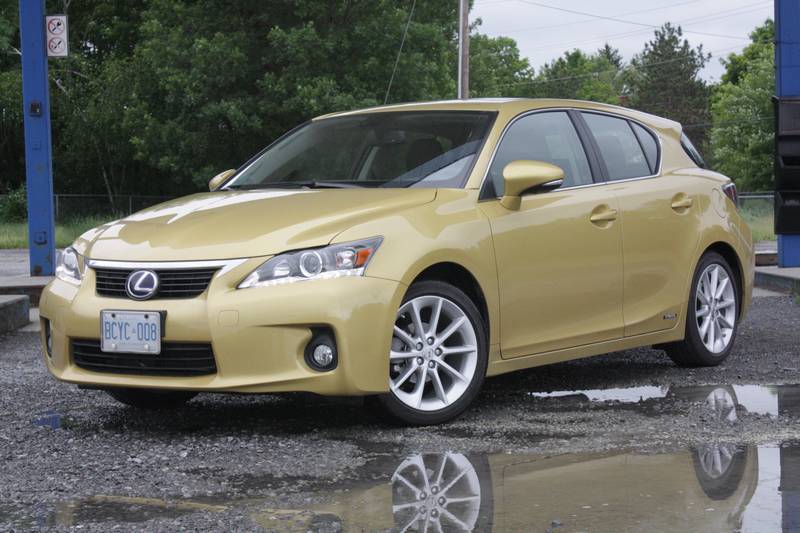
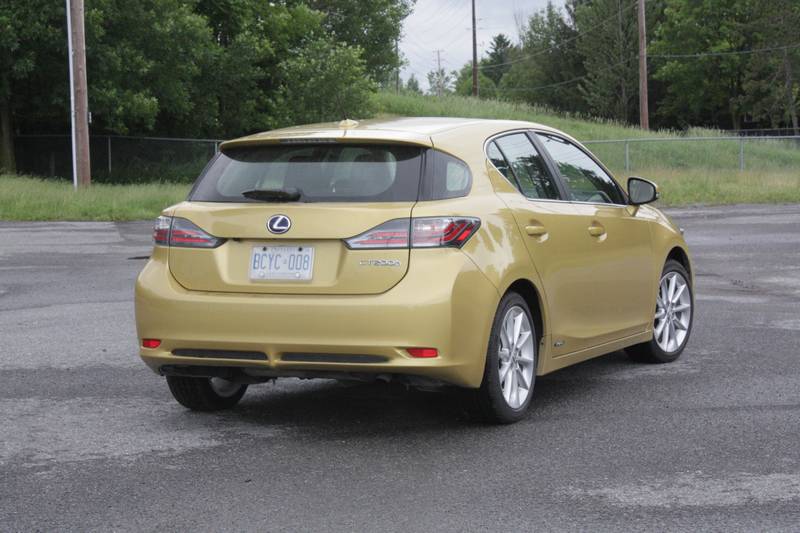
But now, here’s Lexus, with the 2011 CT 200h, a compact hybrid hatchback that its maker says is designed for “moments of fun.” As a hybrid, it’s got the specs: the combination of 1.8-litre gasoline engine and electric motor comes more or less untouched from the Prius, by Lexus’ parent company, Toyota.

2011 Lexus CT 200h

2011 Lexus CT 200h

In pursuit of the sporty half of the equation, Lexus fine-tuned the drivetrain, making modifications designed to coax more performance out of the gas-electric power pair. The CT 200h’s 134 horsepower and torque (105 lb-ft from the gas engine, and 153 from the electric motor, although the net total is something between those two numbers) match those in the Prius.

The CT 200h’s fuel consumption numbers are not the same, though; owing to different throttle and engine control programming, the Lexus’ Natural Resources Canada (NRCan) ratings are 4.5/4.8 L/100 km in the city and highway test cycles, respectively, compared to the Toyota’s 3.7 and 4.0 L/100 km. My Lexus test car averaged an impressive 4.9 L/100 km in city driving, which is actually better than the 5.2 L/100 km my 2010 Prius tester managed.

On paper, those fuel ratings and Lexus’ marketing claims suggest that this Lexus is the very definition of guilt-free wheeled entertainment. Guilt-free, yes, but entertaining… well, that depends on what you expect.

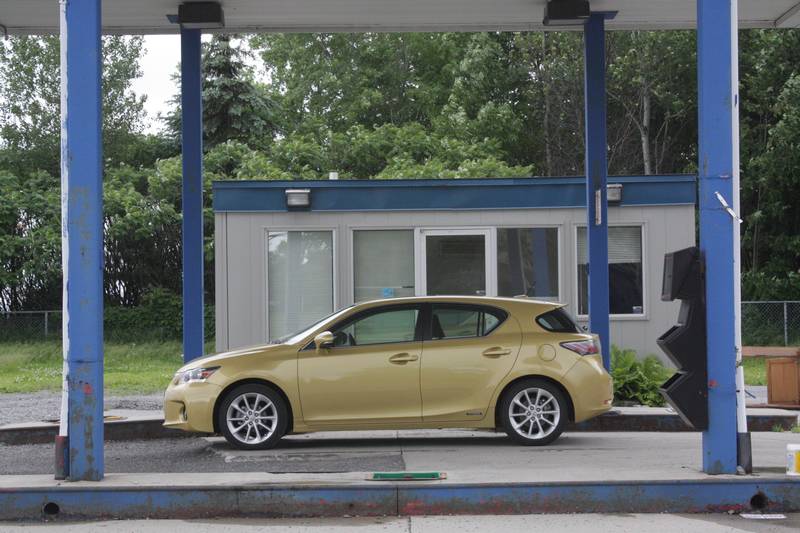
2011 Lexus CT 200h

2011 Lexus CT 200h

The CT 200h is more agile in corners than the Prius, balancing sharp handling with a comfortable ride. Short of paying stacks of cash for a Porsche Panamera or Cayenne Hybrid, BMW’s hybrid X6 SUV or even Lexus’ own hybrid GS luxury sedan, you won’t find another hybrid this affordable that also allows for this much fun on bendy roads.

What you don’t get for that low, low price (the CT starts at $30,950) is spirited straight-line performance. If this car is faster than a Prius, you won’t be able to measure the difference by the seat of your pants, and in fact, I couldn’t detect much of any difference in the car’s behaviour compared to the last Prius I drove (though that was a couple of years ago at this point). Stand on the gas pedal, and the car’s continuously variable transmission (CVT) lets the engine run up close to its red line, and keeps it there as the car gains speed. As with any CVT-equipped car, the effect is a little strange compared to the up-and-down soundtrack of a traditional transmission moving through its set gear ratios. Again, though, as with other CVTs, this one keeps engine speeds low in normal driving; that, combined with the electric motor pitching in, makes for a quiet drive, as long as you’re not in a hurry.

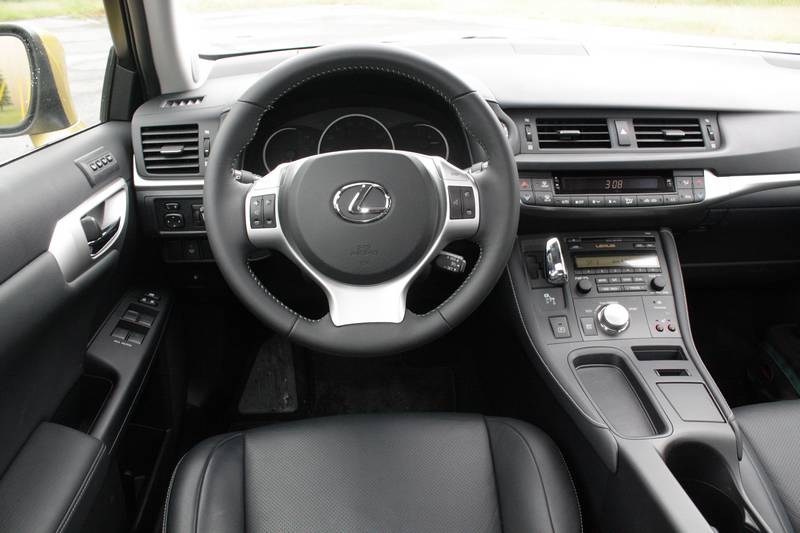
In the gauge cluster, a multi-mode trip computer will display the distance travelled and fuel consumption in L/100 km, or it can be set to show you a hybrid system status screen that shows whether the car is moving on gas or electric power or, most commonly, a combination of both.

2011 Lexus CT 200h

2011 Lexus CT 200h

An “EV mode” (EV meaning electric vehicle) button on the dash forces the car to run on electricity alone, so long as the conditions are right: it works up to speeds of 40 km/h, under moderate acceleration and only when the car’s electronics say the battery has enough charge to pull it off. It’ll work three times out of four you try it. Lexus actually says not to use it too much, as it could cause fuel consumption to increase through repeatedly draining the battery and then requiring the gas engine to run to recharge it. It’s meant, suggests Lexus, as a convenient way to provide a quiet running mode for driving through residential areas late at night – not that most cars are loud enough to wake up the neighbours, unless you’re doing donuts in their driveway.

There are three different other drive modes beyond EV mode, one of which is a sport setting that brings quicker throttle response – as in, you get more power for less movement of the gas pedal – but doesn’t actually add any power. The other two choices are “eco,” which aims to save fuel by reducing gas pedal sensitivity, encouraging more leisurely driving, and a “normal” setting that strikes a middle ground and ultimately makes for the best driveability.

2011 Lexus CT 200h

2011 Lexus CT 200h

Interior finishings look and feel like quality, with the exception of the speaker covers in the dash top, which didn’t fit flush with the rest of the dash panel. But that’s a relatively minor thing in an otherwise nicely put-together car. The CT does away with the Prius’ high-tech interior look, presenting analog gauges for speed, fuel and a third gauge that can be toggled between a hybrid system power display or a more traditional tachometer, which is switched to automagically when sport mode is selected.

2011 Lexus CT 200h

2011 Lexus CT 200h

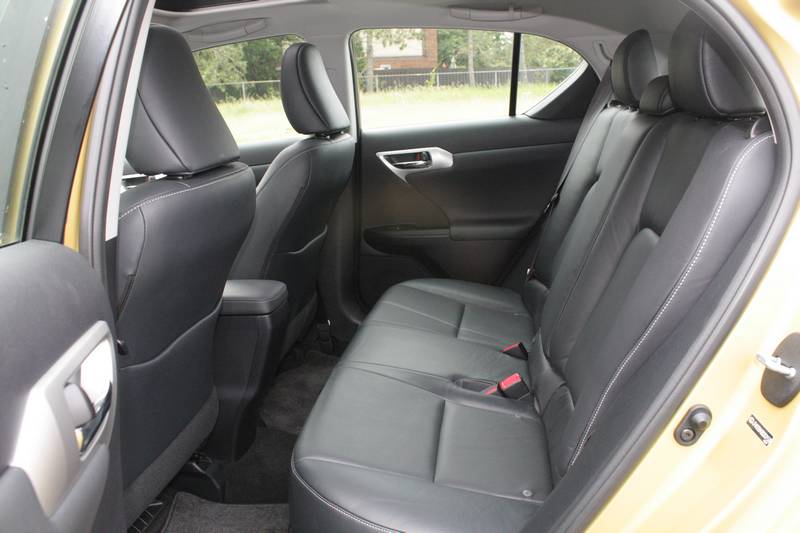
This is a small car, and the proof is found inside, where headroom is tight, and rear seat legroom is about equivalent to a compact hatchback, like the Mazda3 or Kia Forte5. Where the most space is lost, though, is in the trunk, where the high floor, dictated by the placement of the hybrid system’s battery pack, takes a significant cut out of cargo space. Naturally the rear seats fold (so do those in the Prius, but hybrid sedans, like the Ford Fusion, Toyota Camry and Nissan Altima lack a folding rear seat), usefully expanding trunk space.

2011 Lexus CT 200h

2011 Lexus CT 200h

To my test car, Lexus added the $4,900 Premium Package, which includes 17-inch alloy wheels (replacing 16-inchers on the base model), six-CD changer, 10-speaker stereo, driver’s seat memory, leather seats, power sunroof, auto-dimming side and rear view mirrors and backup camera. With that, the as-tested price came to $35,900 before taxes and fees.

It wasn’t long ago that the less-interesting Prius sold for something similar to the CT 200h’s $31,000 base MSRP, proof that hybrid technology is moving closer to the core of the new car market. Still, it’d take years to make back the price difference between this Lexus and a similarly-equipped Mazda3 Sport hatch – the top-line version costs $28,765 with navigation and steerable headlights, which my Lexus tester didn’t have – and the Mazda is a more engaging car to drive. But if your goal is to save fuel and have “moments of fun” doing it, then the CT 200h fits the bill.

For more information, see Lexus.ca.


The Big Idea: Practicality in its prime

As a vehicle type, the minivan is nearly 30 years old. Therefore, most of the major innovations have come and, if they were good ideas, stuck around. Think along the lines of dual sliding doors, seats that fold away into the floor and, gimmicky as it might be, the swivelling second row seats and hideaway table offered in the Dodge Grand Caravan.

So, what’s left? Not much, but a handful of manufacturers have included a couple of small, but useful, features in their recently-redesigned minivans.

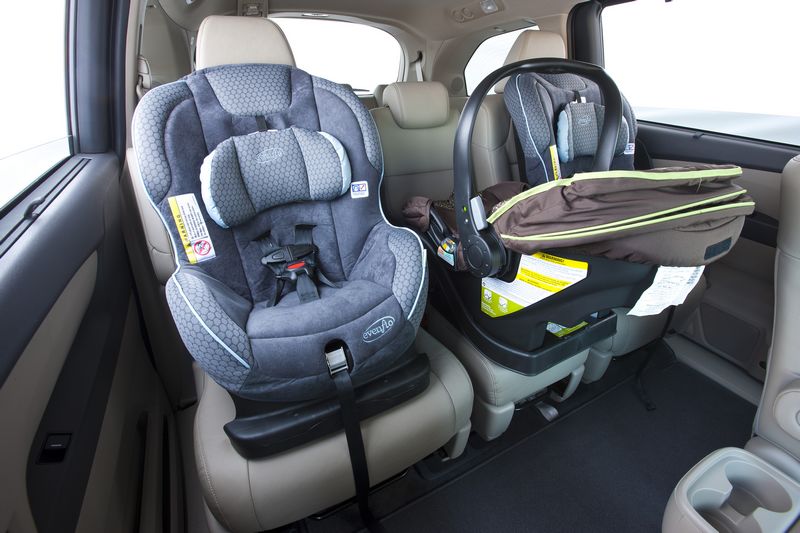
In the Honda Odyssey, the second-row seats can move a few inches side-to-side, providing space to set three child seats across. And here’s a why-didn’t-I-think-of-that feature: a garbage bag ring that folds out of the back of the front-seat centre console – no more searching for an out-of-the-way place to hang a trash bag during those rolling road-trip fast-food lunches.

2011 Honda Odyssey Touring Elite

2011 Honda Odyssey Touring Elite; photo courtesy Honda. Click to enlarge

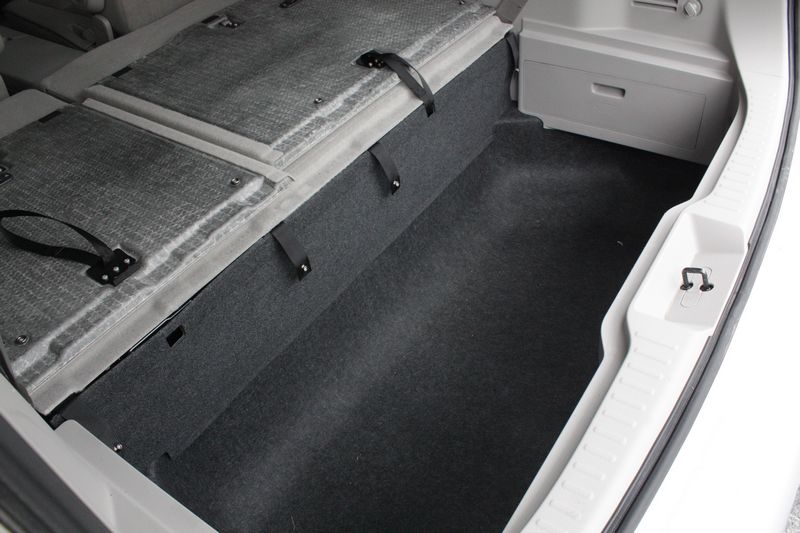
Every minivan available at the moment has a third-row seat that folds away into the floor; the cavity it fits into can be used for cargo when the seat is upright. But Nissan did something unique in its 2011 Quest by designing the seat to fold forward, instead of toward the back, leaving that storage well free even when the seat is stowed. Hard panels that fit over the opening provide out-of-sight storage for valuables.

2011 Nissan Quest SL

2011 Nissan Quest SL; photo by Chris. Click to enlarge

Less practical, but still cool, is the second-row lounge seat that can be optioned into the Toyota Sienna, creating the kind of luxurious seating normally reserved for ultra-luxury sedans.

2011 Toyota Sienna Limited V6

2011 Toyota Sienna Limited V6; photo courtesy Toyota. Click to enlarge.

What will they think of next for this most versatile of vehicle type? We’ll have to wait a few years, until the next round of redesigns, to find out.


Tags: , , , , ,

What I Think: 2011 Hyundai Elantra

By Chris Chase

It was a long time coming, but Hyundai finally knows what it feels like to be on top: for a time, in the early part of 2011, the new Elantra compact sedan was the best-selling car in Canada.

2011 Hyundai Elantra Limited

2011 Hyundai Elantra Limited; photo courtesy Hyundai. Click to enlarge.

It’s a noteworthy accomplishment, but this new Elantra is also a noteworthy car that is new from the wheels up. Under its restyled – and verging on overstyled – sheetmetal is a 1.8-litre four-cylinder engine, producing 148 horsepower and 131 lb-ft of torque. It’s a smoother-running motor than the 2.0-litre that powered the previous Elantra, but can feel a bit weak at low revs; at least running it out to its 6,600 rpm redline generates satisfying sounds and strong acceleration.

2011 Hyundai Elantra Limited

2011 Hyundai Elantra Limited; photo courtesy Hyundai. Click to enlarge.

The six-speed automatic transmission, a nice step up from the old car’s four-speed auto, works well, shifting smoothing and responding eagerly to the throttle with downshifts when more speed is required. Even the manual shift mode, typically an afterthought in anything but a sports car, works almost well enough to satisfy an enthusiast who misses driving stick.

That enthusiast will be better entertained by the Elantra’s handling, which is a far sight more fun than the last generation’s. The ride is taut but not uncomfortable, and the suspension takes well to being tossed into a fast corner. If there’s a criticism, it’s how easily the rear suspension loses its composure on rough surfaces and skitters side-to-side. Quite a lot of road noise gets into the cabin at highway speeds, too.

Like the outside, the Elantra’s interior is attractive, but the daring design runs the risk of looking dated in a couple years’ time. The dual-zone, automatic climate controls that are standard in the Limited model, like my tester, are an ergonomic weak point: the small rocker switches that control driver and passenger temperature settings aren’t well-placed considering that they’ll arguably be used the most. The fan speed control, largely ignored by many drivers who use automatic climate systems, is, by contrast, a perfectly-placed, large dial.

2011 Hyundai Elantra Limited

2011 Hyundai Elantra Limited; photo courtesy Hyundai. Click to enlarge.

The interior is impressively roomy, particularly in the back seat, which approaches mid-sized sedan comfort and space. The front seats are less comfortable, at least to my own lower back; your mileage my vary. The trunk, at 420 litres (14.8 cu. ft.) in size, is large for the compact sedan class, and the rear seats fold almost flat to expand carrying capacity.

Another improvement comes in the new Elantra’s fuel consumption ratings, at 6.9 L/100 km (city) and 4.9 L/100 km (highway), according to Natural Resources Canada. Impressive, yes, but these estimates are always optimistic; on an 80km/h run along a secondary road, I saw an indicated average of 5.5 L/100 km on the car’s trip computer, but travelling at prevailing multi-lane highway speeds of about 110 km/h bumped that figure up to 6.7 L/100 km. That’s a good result, but I’ve driven other small cars that have managed similar numbers.

Much of Hyundai’s success is staked on its policy of packing lots of equipment into its cars at prices that undercut the competition. The Elantra follows that philosphy, including power windows, locks and mirrors and a USB and auxiliary input in the $15,849 base L model, while air conditioning, heated seats, a telecoping steering wheel with audio controls, cruise, Bluetooth connectivity and upgraded 16-inch wheels are standard in the $17,999 GL. For less than $20,000, the GLS adds a sunroof and, unbelievably, heated rear seats.

My tester, the $22,699 Limited trim, includes leather seats, automatic climate control and the automatic transmission, which, by itself, is a $1,200 extra in the lower trims. Limited with navigation is worth $24,699.

I fully understand Hyundai’s desire to load its cars up for less money than expected: low prices and long lists of standard features look good next to each other, for sure. A car’s value equation also includes how it drives, however, and I’d gladly trade a couple of this car’s niceties for a quieter, more composed highway ride.